
 English
 Español
hsau hsau hsau hsau hsau
hsau hsau hsau hsau

A maintenance engineer at an automotive battery-line integrator has to replace a welded steel machine frame that weighs 186 kg. The T-slot aluminum frame designed to the same outer envelope weighs about 64 kg before machining. That 122 kg gap is why the density of aluminum vs steel (2.70 g/cm3 against roughly 7.85 g/cm3) is one of the first numbers quoted in any structural material comparison.
But density alone decides nothing; it only opens the analysis. The real outcome depends on how density interacts with yield strength, Young's modulus, cross-section geometry, and assembly method. This article provides the reference values, explains the strength-to-weight and stiffness math, and lays out a practical selection framework for aluminum extrusion versus steel sections.
Content
Steel is about 2.9 times denser than aluminum, and that ratio remains nearly constant across common structural grades. Aluminum 6061-T6 measures 2.70 g/cm3, A36 carbon steel measures 7.85 g/cm3, and stainless steel 304 measures approximately 8.00 g/cm3.
Density of common structural metals in g/cm3. Steel is roughly three times as dense as aluminum.
In imperial units, aluminum 6061 sits at 0.098 lb/in3 and steel at 0.284 lb/in3, preserving the same 2.9x ratio. Alloying shifts the values only slightly: 7075-T6 reaches 2.81 g/cm3, while high-strength and stainless steels stay in the 7.75 to 8.10 g/cm3 range.
The table below adds yield strength, modulus of elasticity, and specific strength for five metals that regularly compete in industrial frames.
| Material | Density g/cm3 | Yield MPa | E GPa | Specific strength kN-m/kg |
| Aluminum 6061-T6 | 2.70 | 276 | 68.9 | 102 |
| Aluminum 7075-T6 | 2.81 | 503 | 71.7 | 179 |
| Steel A36 | 7.85 | 250 | 200 | 32 |
| Steel A572 Grade 50 | 7.85 | 345 | 200 | 44 |
| Stainless steel 304 | 8.00 | 205 | 193 | 26 |
In yield-limited design, aluminum 6061-T6 delivers roughly three times the load capacity of A36 steel for the same weight.
Specific strength equals yield strength divided by density. It expresses how much load a kilogram of material can carry before yielding.
Running the numbers on five structural grades makes the pattern clear.
Extrusion suppliers translate this into practical geometry: a high-strength 3030 profile with a 2.0 mm wall carries a noticeably higher load than a standard 3030 section at only a small increase in mass per meter. Specifying wall thickness is often a faster route to load capacity than jumping to a larger series.
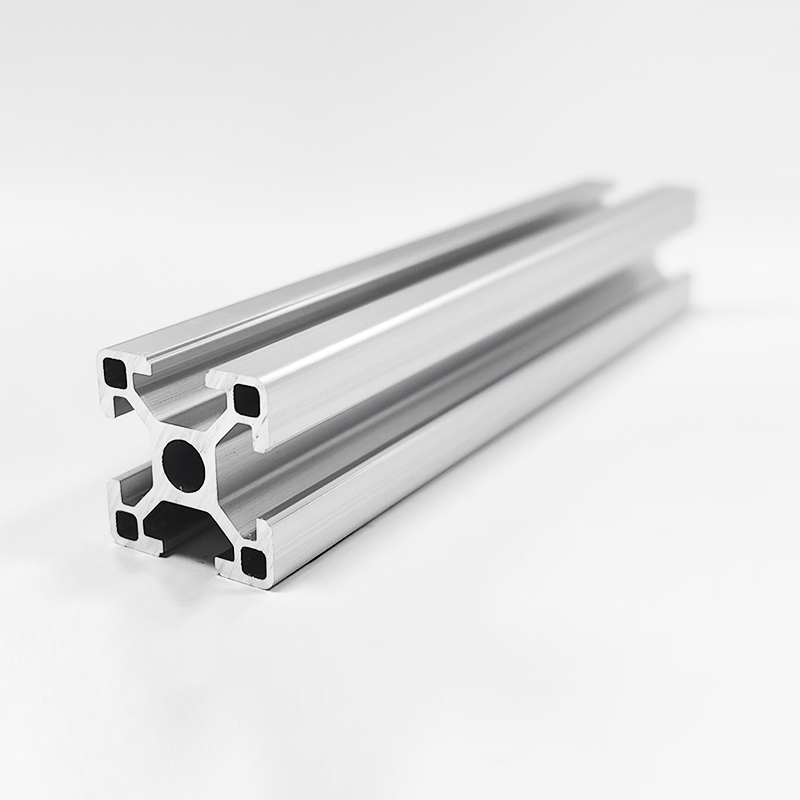
 HS-8-3030A High-Strength 3030 T-Slot Aluminum Profile with 2.0mm WallThis 30x30mm profile with a thickened 2.0mm wall and 0.85kg/m weight boosts load capacity over standard 3030 sections, making it a practical choice for fatigue- and deflection-limited frames where stiffness matters.View Product →
Fatigue changes the picture. Steel has a fatigue endurance limit around 40 to 50 percent of its ultimate strength, meaning it can cycle indefinitely below that stress. Aluminum has no true endurance limit, so highly cyclical applications often justify steel even at a weight penalty.
For a stiffness-controlled beam, you do not compare density alone; you compare bending stiffness, which is the product of Young's modulus (E) and the moment of inertia (I) of the cross-section. A steel beam's 2.9x higher modulus is offset by an aluminum section's ability to carry more material further from the neutral axis.
A 100 x 100 x 3 mm steel square tube has a moment of inertia of 1.83 x 106 mm4 and weighs 9.1 kg/m. An aluminum 120 x 120 x 5 mm square tube has a moment of inertia of 5.08 x 106 mm4.
Bending-stiffness ratio: (68.9 GPa x 5.08) / (200 GPa x 1.83) = 0.96, within 4 percent of the steel member's stiffness. Weight: 6.2 kg/m versus 9.1 kg/m, a 32 percent saving.
If you scale the aluminum section until it matches the steel weight, a 170 x 170 x 5 mm tube delivers roughly 2.8 times the steel's bending stiffness.
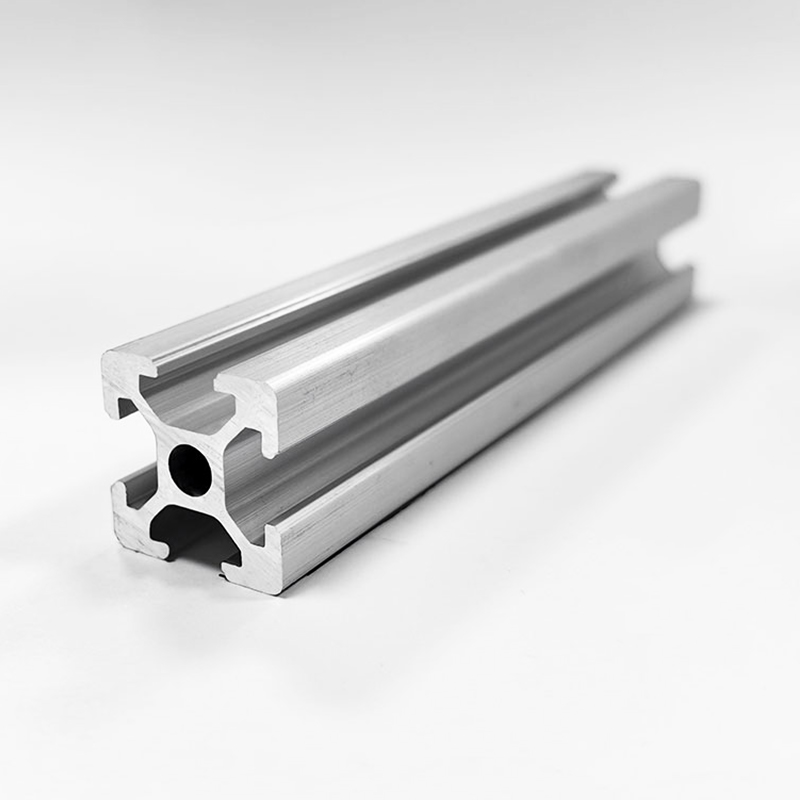
T-slot aluminum extrusions make this geometry effect easy to exploit. Hollow profiles with reinforced walls, deep slots, and wide flanges provide high moments of inertia per kilogram, which is exactly what deflection-limited frames need.
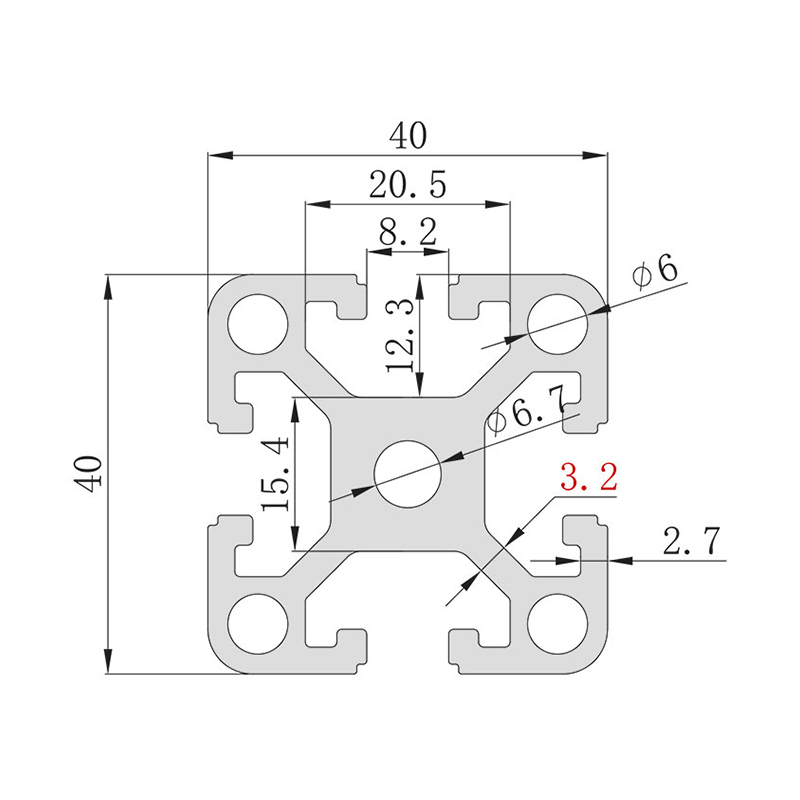 HS-8-4040D High-Strength 4040 T-Slot Aluminum Profile with 3.2mm WallFeaturing a 3.2mm thickened wall and no pre-drilled holes, this 40x40mm profile offers high stiffness per kilogram. It suits heavy frames where column buckling and deflection are critical design considerations.View Product →
Buckling adds another layer. Column buckling load depends on EI divided by the square of the unsupported length, so a frame leg built from the deeper aluminum section inherits the same stability advantage. For frames with tall vertical posts, this matters more than yield strength.
The selection rule is direct: use aluminum when mass, corrosion, modularity, or machining cost matters; use steel when stiffness per unit volume in a fixed envelope, temperature resistance, or raw material cost dominates.
A common hybrid solution puts steel base plates and heavy-duty legs under an aluminum T-slot upper structure. The steel carries concentrated anchor loads, while the aluminum frame keeps the overhead weight low.
For demanding machine frames, manufacturers such as Shanghai Huishuo Aluminum Industry Technology Co., Ltd. combine heavy-duty 6061 profiles with custom mold making, CNC machining, and anodized surface finishing. Heavy-load series from 40 mm to 120 mm allow engineers to match wall thickness and slot geometry to the stiffness target.
 HS-10-4545 Heavy-Duty 4545 T-Slot Aluminum Extrusion with 2.4mm WallThis 45x45mm heavy-duty profile uses high-strength 6063-T5 alloy and a 10.2mm slot for high-torque connections. Ideal for large machinery bases and point-loaded structures that demand maximum stability.View Product →
When a design must carry concentrated point loads, check the deflection of the unsupported span rather than relying on density ratios alone. The 30, 40, and 45 series include thickened-wall high-strength profiles that meet medium- and heavy-duty loads.
Aluminum 6061-T6 is 2.70 g/cm3 (2,700 kg/m3, 0.098 lb/in3). Carbon steel A36 is 7.85 g/cm3 (7,850 kg/m3, 0.284 lb/in3). Stainless steel 304 is about 8.00 g/cm3. Steel is therefore about 2.9 times denser than aluminum.
Usually yes. Aluminum 6061-T6 has a specific strength of about 102 kN-m/kg, while A36 steel sits at 32 kN-m/kg and A572 Grade 50 at 44 kN-m/kg. Only very high-strength steels around 690 MPa yield begin to approach the weight efficiency of 6061-T6.
Stiffness-critical designs with no space to deepen the section, continuous service above 150°C, high-cycle fatigue, and purely material-cost-driven projects. Steel's higher modulus, useful endurance limit, and lower price win in those cases.
Because total installed cost is lower in many machine builds. T-slot extrusion eliminates welding and alignment, accepts standard connectors, survives wash-down environments when anodized, and can be reconfigured for future layout changes.

Phone
+86-021-5788 5585
+86-133 8191 2789
Address
No. 218, Zhongde Road, Xiaokunshan Town, Songjiang District, Shanghai, China
Media
