Aluminum Profile Frame – Modular Framing for Industrial Applications
An aluminum profile frame is a modular structural system built from extruded aluminum profiles, connectors, and accessories. It replaces welded steel frames in machine guards, workstations, conveyor supports, automation bases, and cleanroom enclosures. The key procurement advantage is reconfigurability: frames can be disassembled and reused, reducing lifecycle cost. As a China-based Aluminum Profile Frame manufacturer, Shanghai Huishuo Aluminum Industry Technology Co., Ltd. offers standard and custom frames using its own extrusion profiles and accessories. the category provides the technical and commercial data needed to specify, compare, and purchase aluminum profile frames.
Core Components and System Architecture
An aluminum profile frame consists of three element types:
- Profiles – T-slot extrusions in series from 15 to 120 mm cross-section. Slot width (6, 8, or 10 mm) determines compatible fasteners. Wall thickness varies from 1.4 mm (lightweight) to 15 mm (ultra-heavy-duty).
- Connectors – Internal and external brackets, angle brackets, corner gussets, and joining plates. See Aluminium Profile Connectors for options.
- Fasteners and finishing parts – T-nuts, bolts, end caps, slot covers, and leveling feet. Refer to Aluminium Profile Fasteners and Aluminium Profile Finishing Parts.
Frame design must account for static load, dynamic load (vibration from motors or conveyors), and environmental factors (temperature, humidity, chemical exposure). The Industrial Aluminum Extrusion Profiles category lists all available series with cross-section drawings.
Series Selection – Matching Profile Size to Load and Span
Profile series (15, 20, 25, 30, 40, 45, 50, 60, 80, 90, 100, 120) indicate the cross-section width in millimeters. Larger series carry higher loads and allow longer unsupported spans. The table below summarizes typical applications:
| Series |
Slot Width |
Typical Wall Thickness |
Recommended Load Range |
Common Applications |
| 15–20 |
6 mm |
1.2–2.0 mm |
Light (≤50 kg/m) |
Small enclosures, display stands, light-duty guards |
| 30–40 |
8 mm |
1.5–3.0 mm |
Medium (50–200 kg/m) |
Workstations, machine guards, light conveyor frames |
| 45–60 |
8 or 10 mm |
2.0–4.5 mm |
Medium–heavy (200–500 kg/m) |
Automation bases, heavy guards, gantry supports |
| 80–120 |
8 or 10 mm |
3.0–15 mm |
Heavy–extreme (500–2000+ kg/m) |
Large-span frames, heavy equipment bases, press structures |
For extreme loads, consider the HS-8-120120 Ultra-Heavy-Duty T-Slot Aluminum Extrusion Profile with 15 mm wall thickness. For medium-duty automation frames, the HS-8-8080C Heavy-Duty Reinforced 8080 series provides high rigidity.
Custom Frame Design and Fabrication Services
A reliable Aluminum Profile Frame supplier offers end-to-end services: design assistance, profile cutting, CNC machining, surface treatment, and assembly. Huishuo provides one-stop custom frames including:
- Profile cutting – to ±0.5 mm tolerance.
- CNC machining – drilling, tapping, milling, and counterboring for connectors. Machining diameter up to 6.5 m with 0.01 mm precision.
- Surface treatment – anodizing (silver, black), powder coating (any RAL), electrophoretic coating, and fluorocarbon painting.
- Assembly – partial or full assembly per your BOM and drawings.
Submit a 2D or 3D drawing for quotation. The supplier will generate a detailed BOM including profile lengths, connectors, fasteners, and finishing parts. Verify that the design accounts for tolerance stack-up in multi-bay frames and access for cable routing.
Quality Assurance and Acceptance Testing
Before accepting a frame, confirm the following quality checks:
- Dimensional accuracy – overall frame dimensions within ±1 mm; squareness within 0.5 mm per meter.
- Surface finish – uniform anodizing or coating, no scratches or pitting.
- Load test – if specified, a static load test at 1.5× rated load with deflection measurement.
- Fastener torque – all bolted joints tightened to specified torque.
Huishuo’s quality control department uses image measuring instruments, tensile testers, and coordinate measuring machines. Request a certificate of conformance and, for critical frames, a dimensional inspection report.
Buyer RFQ Checklist
Use this checklist when requesting a quotation for an aluminum profile frame:
- Application details – describe the machine or process, load type (static/dynamic), environment (temperature, humidity, chemicals).
- Frame dimensions – overall length, width, height; number of bays; access openings.
- Profile series – specify cross-section (e.g., 40×40, 80×80) and slot width (6, 8, 10 mm).
- Wall thickness – minimum acceptable thickness for the load.
- Material grade – typically 6063-T5 or 6061-T6; confirm if T6 is needed for higher strength.
- Surface treatment – anodizing (clear, black, bronze) or powder coating (RAL code).
- Connector type – internal or external brackets; specify if concealed joints are required.
- Accessories – leveling feet, casters, hinge doors, polycarbonate panels, cable trays.
- Machining requirements – drilling, tapping, counterboring; provide hole positions on drawing.
- Assembly level – cut only, cut + machined, or fully assembled.
- Delivery – required date, packaging (crate or pallet), shipping terms (EXW, FOB, CIF).
- Documentation – 2D drawing, 3D model (STEP/IGES), BOM, inspection report.
- Warranty – typical 12 months against manufacturing defects; confirm coverage.
Total Cost of Ownership Considerations
Aluminum profile frames have a higher initial material cost than welded steel, but lower TCO due to:
- Reusability – frames can be disassembled and reconfigured for new layouts.
- No welding – no need for certified welders, no weld inspection, no post-weld stress relief.
- Faster assembly – modular connectors reduce labor time by 30–50% compared to welding.
- Corrosion resistance – anodized aluminum does not require painting, reducing maintenance.
When evaluating suppliers, compare profile cost per kg, connector cost per joint, and machining cost per operation. A supplier that also manufactures profiles and accessories (like Huishuo) can offer bundled pricing and ensure compatibility.
Supplier Evaluation Criteria
When selecting an aluminum profile frame manufacturer, assess:
- Extrusion capability – number of extrusion lines, maximum profile size, tonnage range (600T to 5000T).
- CNC capacity – number of machining centers, maximum workpiece size, tolerance capability.
- Surface treatment lines – anodizing, powder coating, electrophoresis; maximum length (e.g., 14 m anodizing pool).
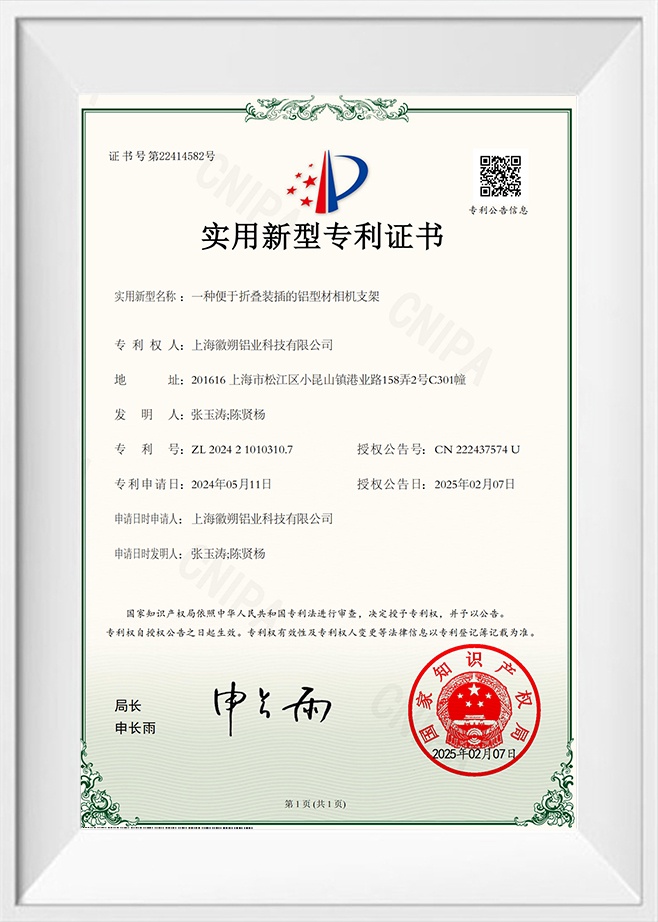
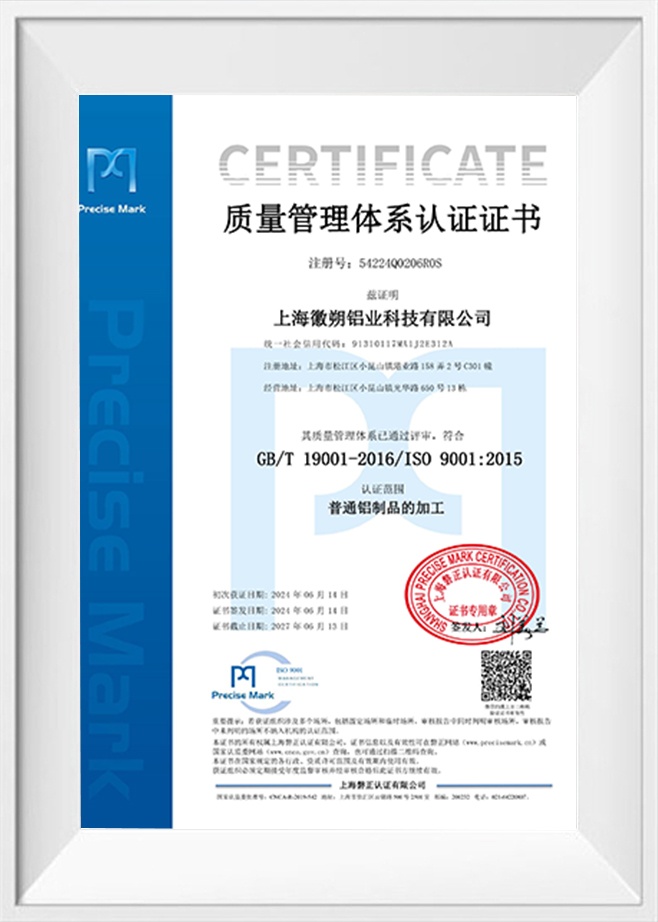
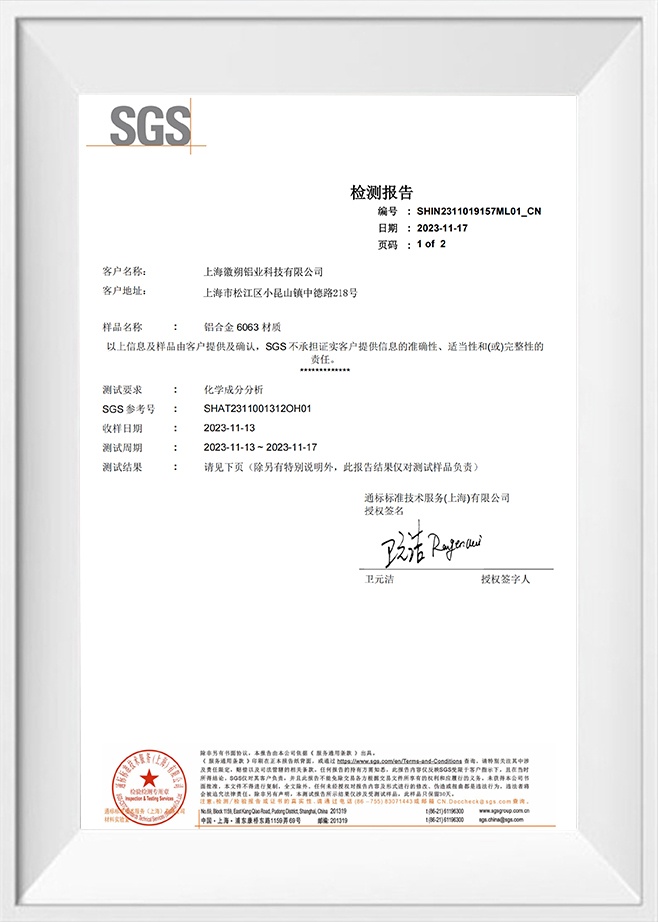
- Quality certifications – ISO 9001, test reports, patents.
- Reference projects – request case studies of similar frames delivered.
- Lead time – typical 2–4 weeks for standard frames; 4–8 weeks for custom with mold making.
Huishuo’s Factory Tour page shows extrusion lines, CNC shops, and assembly workshops. Their Certificate page lists ISO 9001 and utility model patents.
Frequently Asked Questions
What is the difference between 6063-T5 and 6061-T6 aluminum for frames?
6063-T5 is the standard for T-slot profiles due to its excellent extrudability and surface finish. 6061-T6 offers higher tensile strength (310 MPa vs 240 MPa) but is more difficult to extrude and may have a rougher surface. Use 6061-T6 only when the frame must withstand very high static loads or impact.
Can I get a frame with concealed fasteners for a clean appearance?
Yes. Internal connectors (e.g., anchor bolts, blind joints) hide all fasteners inside the profile slots. This is common for cleanroom frames and aesthetic enclosures. Specify “concealed joint” in the RFQ.
How do I calculate the required profile size for a given load and span?
Use the beam deflection formula: δ = (5 × w × L⁴) / (384 × E × I), where w = load per unit length, L = span, E = modulus (69 GPa for 6063), I = moment of inertia from the profile datasheet. Set maximum deflection to L/500 for precision frames or L/200 for general use. The supplier can provide deflection tables for each series.
What is the typical lead time for a custom aluminum profile frame?
For standard profiles and connectors, 2–4 weeks from drawing approval. If a new extrusion die is needed (custom cross-section), add 2–3 weeks for mold making and sample approval. Always confirm lead time in writing before placing the order.
Do you provide on-site installation or assembly drawings?
Most suppliers provide assembly drawings (exploded view and BOM). On-site installation is typically not included, but the frame can be shipped fully assembled or in sub-assemblies. For large frames, consider modular design with bolted connections for easy field assembly.
What surface treatment is best for outdoor or corrosive environments?
For outdoor use, specify powder coating (minimum 60 μm thickness) or fluorocarbon painting (PVDF) for UV resistance. For corrosive environments (chemical plants, marine), use electrophoretic coating or heavy anodizing (20–25 μm).

 English
 Español