
 English
 Español
hsau hsau hsau hsau hsau
hsau hsau hsau hsau

A 6063-T5 bar extruded at around 480 degrees Celsius and cooled in still air reaches a yield strength near 145 MPa while weighing only 2.70 g/cm3, about one third the density of steel. Those two numbers explain most decisions in industrial framing projects covering machine bases, guarding, workstations, and conveyor structures. Aluminum alloy properties, however, are never a single number on a datasheet. They are a set of trade-offs among strength, weight, corrosion resistance, conductivity, and manufacturability, and the wrong balance shows up quickly as a frame that deflects under load or a surface that stains in a wet workshop. At Shanghai Huishuo Aluminum Industry Technology Co., Ltd., profile selection conversations start from these properties, because the alloy and temper chosen at the die stage decide everything that follows: wall thickness options, load class, finish quality, and final cost. This guide sets out the properties that matter, compares the common alloy families with real figures, and turns those figures into a practical ordering checklist.
Content
Aluminum alloy properties are the measurable characteristics of a given alloy, including density, strength, corrosion resistance, conductivity, and workability, that decide whether it will survive a specific application.
Pure aluminum is soft and ductile, ideal for foil and conductor cable but nearly useless for a load-bearing frame. Alloying changes that. Controlled additions of magnesium, silicon, copper, manganese, or zinc, combined with the right working and heat treatment, lift ultimate tensile strength from roughly 90 MPa in commercial-purity 1100 to about 570 MPa in 7075-T6, while density stays close to 2.70 g/cm3 across almost the whole range.
For industrial T-slot framing, the practical decision comes down to 6063 for standard profiles and 6061 where higher loads or heavy CNC machining are involved.
The four-digit designation announces the main alloying element: 1xxx is commercial purity, 2xxx copper, 3xxx manganese, 5xxx magnesium, 6xxx magnesium plus silicon, and 7xxx zinc. Each family trades extrudability against strength in a predictable way, and the table below collects typical room-temperature values.
| Alloy and temper | Main alloying elements | Tensile strength | Yield strength | Density | Typical use |
| 1100-O | 99.0 percent Al minimum | 90 to 130 MPa | 35 MPa | 2.71 g/cm3 | Foil, chemical and food equipment |
| 5052-H32 | 2.5 percent Mg | 230 MPa | 195 MPa | 2.68 g/cm3 | Sheet metal, marine and transport parts |
| 6063-T5 | Mg 0.45 to 0.9, Si 0.2 to 0.6 | 185 MPa | 145 MPa | 2.70 g/cm3 | T-slot profiles, architectural framing |
| 6061-T6 | Mg 0.8 to 1.2, Si 0.4 to 0.8 | 310 MPa | 270 MPa | 2.70 g/cm3 | Structural parts, CNC machined components |
| 7075-T6 | Zn 5.1 to 6.1, Mg 2.1 to 2.9, Cu 1.2 to 2.0 | 570 MPa | 500 MPa | 2.81 g/cm3 | Aerospace and high-stress tooling |
When a project sits between those two 6-series workhorses, the deciding factors are press-quench response and machining volume. We compare them in detail in our 6061 versus 6063 technical selection guide.
The 6xxx family dominates industrial extrusion because magnesium and silicon form Mg2Si precipitates that respond to heat treatment, so the alloy gains real strength while remaining soft enough to push through complex dies at 450 to 500 degrees Celsius.
The metal leaves the die soft, and what happens over the next few hours sets the final aluminum alloy properties. In the T5 temper the profile is cooled at the press with forced air and then aged, which keeps distortion low across long, slender framing members. In the T6 temper the profile is water quenched and artificially aged at roughly 180 degrees Celsius, which raises strength but also locks in more residual stress, a real consideration on thin walls.
This is why the standard range of industrial aluminum extrusion profiles from a specialist mill is built almost entirely on 6063, with 6061 reserved for heavy structural members and CNC-machined plates.
Once the alloy and temper are fixed, wall thickness and series size become the practical levers for tuning load capacity, stiffness, and cost.
Two 4040 profiles with identical outer dimensions can differ by more than 60 percent in wall thickness, from a 2.0mm economical wall to a 3.2mm high-strength wall. Deflection is governed by the moment of inertia of the cross-section, so the thicker wall holds alignment noticeably longer under the same load.
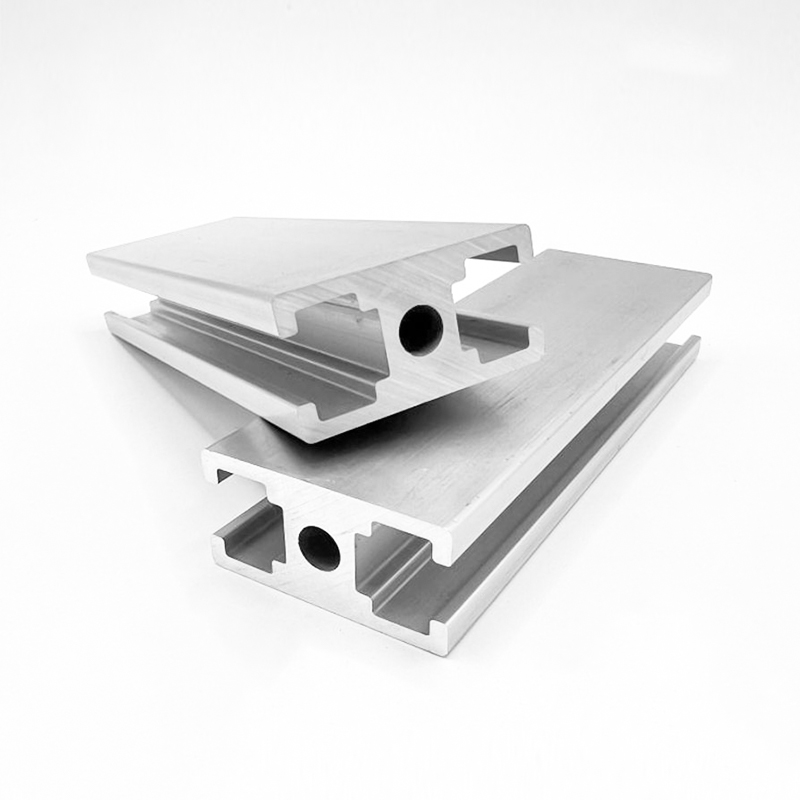
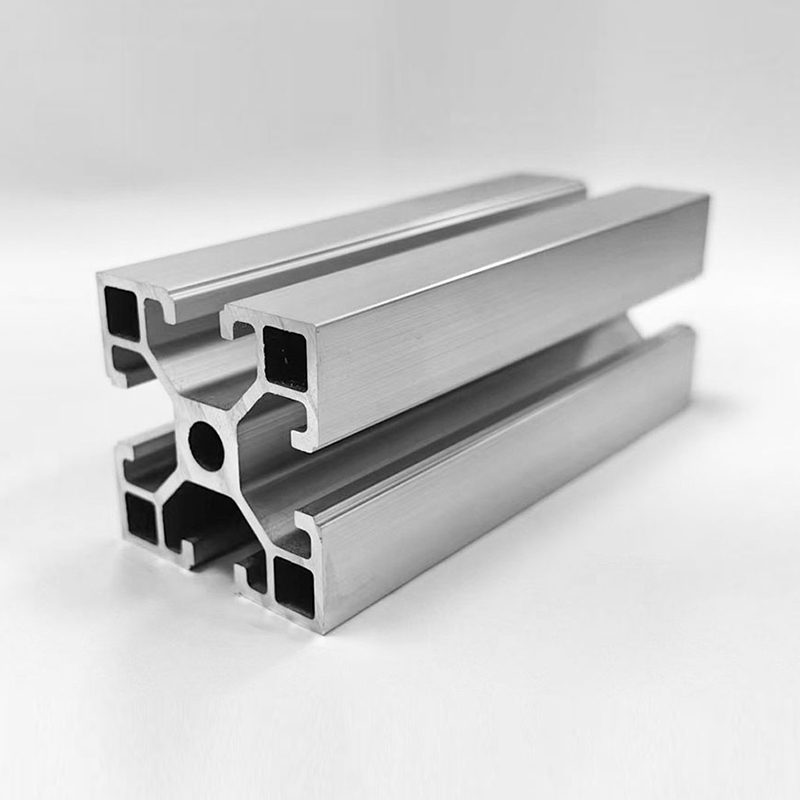 HS-8-4040F Economical 4040 T-Slot Aluminum Profile with 2.0mm WallWith a 40x40mm cross-section, 2.0mm wall, and 8.2mm slot, this economical profile suits cost-sensitive builds. It contrasts with thicker-wall 4040 variants discussed nearby, offering a budget-friendly option for light frames.View Product →
 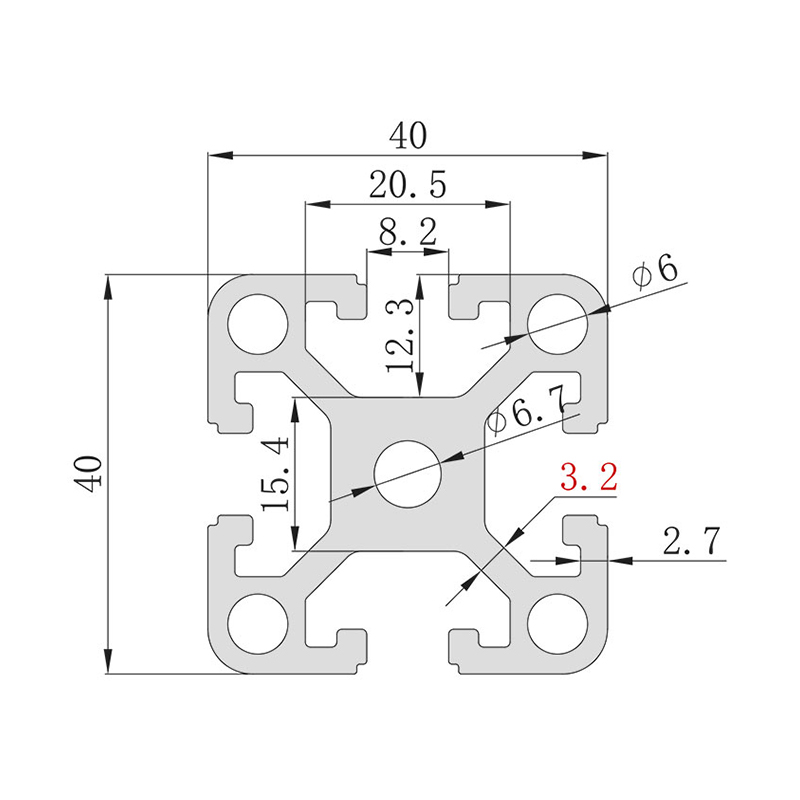 HS-8-4040D High-Strength 4040 Profile with 3.2mm Thickened WallThis 3.2mm-wall 4040 profile weighs 1.88kg/m and resists deflection under heavy loads, directly illustrating the thicker-wall advantage described above. Its no-hole design allows flexible drilling for custom heavy-duty frames.View Product →
Slot width matters as well: a 10.2mm wide slot carries heavier t-nuts and bolts than a 6mm slot, which is why 45 and 50 series profiles anchor most large-span and extra-heavy-duty builds. At the other end of the scale, laboratories and light enclosures prioritize weight and clean handling over raw capacity, which is where thin-wall 3030 variants earn their place.
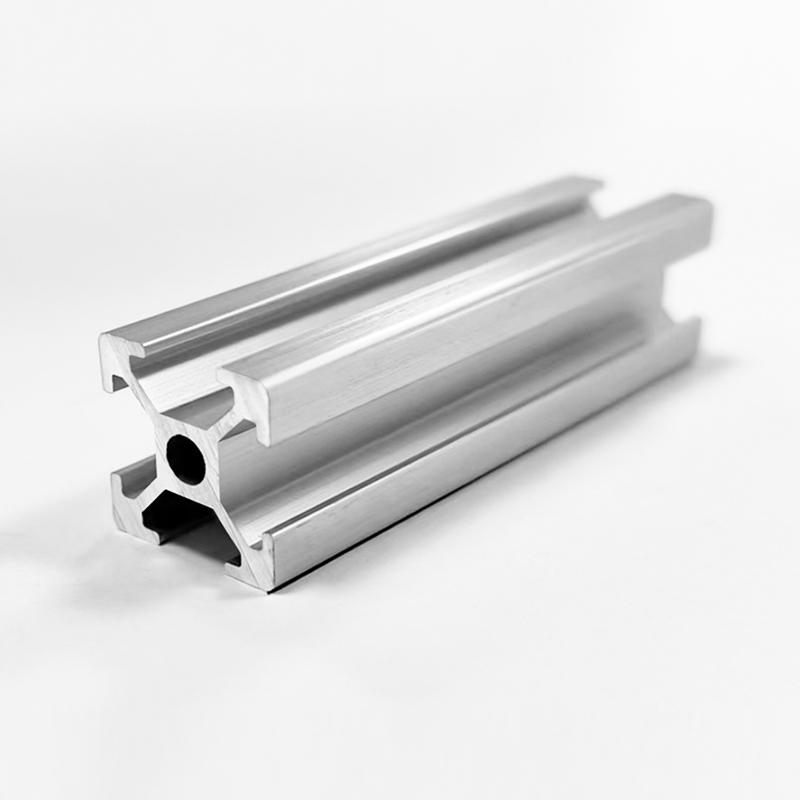
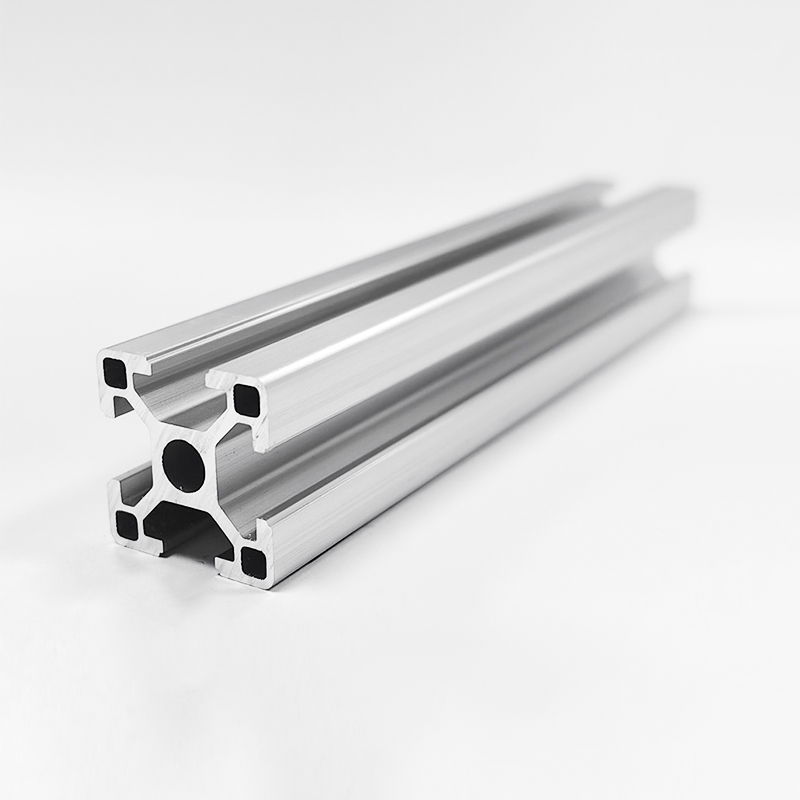
 HS-8-3030QL Lightweight 3030 T-Slot Profile for Laboratory StructuresAt just 0.58kg/m with a 1.4mm wall, this 30x30mm profile fits the light laboratory and enclosure applications mentioned nearby, where weight savings and clean handling matter more than maximum load capacity.View Product →
The headline properties are low density at about 2.70 g/cm3, tensile strength between roughly 90 and 570 MPa depending on series and temper, strong corrosion resistance from the self-repairing oxide film, high thermal and electrical conductivity, and excellent extrudability and machinability.
6063 in T5 or T6 temper is the industry default because it extrudes cleanly into thin, precise slots and anodizes evenly. 6061-T6 is the step-up choice for high-load frames and parts that need substantial CNC machining.
Both start as the same extrusion. T5 is air cooled at the press and aged, reaching about 185 MPa tensile strength, while T6 is water quenched and artificially aged, reaching about 240 MPa. The trade-off is slightly higher distortion risk with T6 on thin sections.
No. Anodizing converts the surface into a 5 to 25 micrometer oxide layer that improves corrosion resistance and surface hardness, but it does not alter the bulk strength of the profile.

Phone
+86-021-5788 5585
+86-133 8191 2789
Address
No. 218, Zhongde Road, Xiaokunshan Town, Songjiang District, Shanghai, China
Media
